
Viewpoint: Ceramic CMMs are right for production environments
What should CMMs be made of? Ceramic, according to our author. How come? The inherent characteristics of ceramic offer performance benefits such as high thermal stability, for increased accuracy, and a high stiffness to mass ratio, for better repeatability.
By Walter Pettigrew, LK Metrology Systems, Inc.
Contents:
Ceramics = Lower C of E
Other Advantages
CMMs are a key part of modern industry. That's a given. What those CMMs should be made of, however, is the subject of an increasingly fierce debate.
The roots of the controversy go back to the early '90s when the industry as a whole moved away from its traditional reliance on granite for CMM bridge and column assemblies. Why? Because lighter weight aluminum yielded faster measurement cycles and thus greater throughput.
The industry split in its choice of alternative construction materials. Some manufacturers turned to ceramics, a recognized metrology material. Others opted for aluminum, which is less costly. Competing CMM firms argued over which was best. Now, after nearly a decade of real-world applications, the results are in.
Ceramics = Lower C of E
The use of ceramic material for CMM bridge and column assemblies allows the CMM manufacturer to ensure a high degree of thermal stability in his machine design, enhancing its measuring accuracy. The key is the lower Coefficient of Thermal Expansion (C of E) exhibited by ceramics.
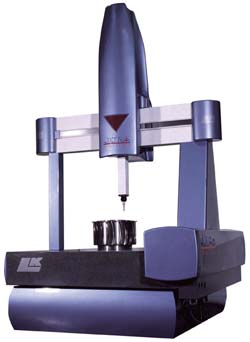
of sub-micron accuracy with 20-millionth-in. repeatability.
Its high precision capabilities are due, in part, to its
ceramic Y and Z beams that provide thermal stability.
As a material, the ceramic used by manufacturers of CMM beam components has a C of E rating almost four times better than that of aluminum — a 6 (ppm/°C), compared to 23 for aluminum. This means that for every temperature increase of a degree centigrade, ceramic will expand at a rate of 6 ppm, and aluminum at the much higher rate of 23 ppm.
Based on the C of E, we can expect that as a component changes temperature, it will change in length. We can also expect that if the component is stress-free and the change of temperature is even across its inside and outside surfaces as well as along its edges, the size change will occur in a linear manner. If it does, and if the C of E is accurately known, it should be possible to predict the magnitude of linear change.
However, this capability depends on two requirements: the accurate determination of the C of E and the homogeneity of the component material. Inexact coefficients and non-homogeneous component materials will skew the size-change predictions. Also important: the larger the temperature change and the larger the C of E affecting a CMM component, the more dramatic and less predictable the effects of inexact coefficients and non-homogeneous component materials.
Compounding the problem is the uncertainty that the Coefficient of Thermal Expansion will, in fact, be determined accurately, because it varies from one batch of material to another. At best, this variation can be controlled to limits of ±10%. In the case of aluminum, that still leaves a substantial uncertainty margin of ±2.3 ppm. For ceramic, the uncertainty is a more modest ±0.6 ppm.
In the real world, too, temperatures will not be even across an entire CMM component. Instead, the components will have a temperature gradient, along with differentials between inside and outside temperature. Moreover, in the form of castings or fabrications, components will have internal stresses and a non-homogeneous structure. They also will be subject to continuously changing temperatures, making it impossible to achieve a stable condition that can be error-mapped for computer compensation.
As a result of these factors, CMM components will invariably expand in a non-linear manner, causing the structure to bend. Because current error-mapping techniques assume linear growth, it's difficult to control the effects of thermal expansion through computer compensations. The best way to control them is to design metrology-critical CMM components with a material that combines practical weight and cost with the smallest possible C of E. Today, the material best able to do that is 96% alumina ceramic.
Back to top
Other Advantages
Another important benefit of the ceramic material is its stiffness-to-mass ratio, which is industry-rated at 8.18, compared to 2.52 for aluminum. The stiffer the CMM bridge or column assembly, the more repeatable the machine performance. In combination with the greater thermal stability of the ceramic material, these advantages result in more accurate and reliable CMM measuring performance.
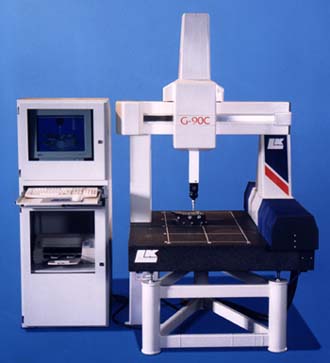
Y-beams using a sophisticated steel belt drive system, contributing to
improved machine performance and reliability. In addition, air bearings
and ceramic guideways enhance precision and stability.
Ceramics also provide an important advantage in terms of CMM guideways, which are critical bearing surfaces and must be ground and lapped to precise flatness. While ceramics can be readily lapped and ground, this is not the case with aluminum, which is a soft material and must first be hardened before undergoing this processing. The hardening may be achieved by flame-spraying with a hardened material or by coating the aluminum with ceramic. In either case, however, it results in a composite material with two rates of thermal expansion that can produce any number of surface distortions.
Aluminum metrology components have been a fad in the CMM industry for almost a decade. However, the proof of a material is in the performance, and aluminum just hasn't made the grade. Based on what we've seen, it's about time that we return, as an industry, to a true metrology material. Standardizing on ceramic could go a long way toward ensuring the accurate, reliable results customers need and expect from today's CMMs.
For more information on the advantages of ceramic for CMM metrology components, contact LK Metrology Systems Inc., 12701 Grand River, Brighton, MI 48116 USA. Tel: 810-220-4360; Fax: 810-220-4300.
About the Author
Walter Pettigrew, vice president of LK Metrology Systems Inc., has been with the company for more than 13 years. He has a bachelor's degree in production engineering and an MBA. He has spent 20 years in the quality industry and has spoken at a national level on multiple subjects within the CMM industry.
Back to top