
Six Sigma: Standard Operating Procedure at GE Fanuc
GE Fanuc's parent, GE, embraced the highest quality standard.
Training every employee in a $100 billion company to have and practice the highest quality standards is not an easy undertaking. But that's just what General Electric did in 1995 with its Six Sigma quality program. In little more than 3 years, GE's success with Six Sigma is now measured in the billions of dollars—with all time records in operating margins and working capital turns.
At GE Fanuc (Charlottesville, VA) Six Sigma is designed to perfect processes—from product design to manufacturing to order entry—through the quality initiative. Over the long term, it greatly reduces the need for troubleshooting and maintenance, as all the important questions already have been asked and the answers are built right into the design. It means getting what you want, when you want it, on time, undamaged, and working.

Measuring Quality
Six Sigma starts with the premise that you can't improve what you don't measure. In fact, the word "sigma" is a statistical term that measures error rates that fall outside an acceptable range. While typical error rates are, on average, about 35,000 per million, Six Sigma calls for 3.4 per million.
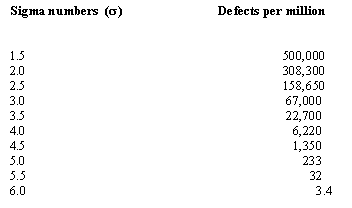
To meet this incredibly demanding goal, project work consists of five basic activities: defining, measuring, analyzing, improving, and then controlling processes. Every project seeks to meet criteria which are known in the Six Sigma realm as the "critical to quality" (CTQ) factors.
In order to manage the extreme demands of Six Sigma, Cimplicity software has become a corporate standard at GE. It's used extensively for the collection, analysis, and presentation of statistical quality data for Six Sigma standards.
• In engineering, Cimplicity is being used to measure and display key customer and product CTQs.
• In manufacturing, Cimplicity constantly monitors and tunes processes to build products at Six Sigma levels.
To date, companies under the GE umbrella have undertaken 20,000 quality initiatives resulting in an average 80% error reduction. As a company open to change, GE has successfully embraced Six Sigma, instituting a Design for Six Sigma (DFSS) process for every new product and service.
Today, the first major products designed for Six Sigma are entering the marketplace, including the VersaMax controller and I/O from GE Fanuc. VersaMax is drawing unprecedented customer accolades because it was, in essence, designed by the customer. In the OEM and end-user arenas, the VersaMax controller offers a scalable solution designed to help customers through ease of use, reliability, lower costs, and higher productivity in applications such as supervisory control and data acquisition (SCADA), packaging, material handling, and remote terminal units.
Is 99% Good Enough?
For many organizations, 99% or a Four Sigma defects per million indicates exceptional quality. But a closer look at these calculations might change your mind.
If applied to these situations, 99% or Four Sigma vs. Six Sigma could mean:
• 20,000 lost pieces of mail every hour (Four Sigma) vs. 7 articles lost per hour (Six Sigma)
• Unsafe drinking water almost 15 minutes every day (Four Sigma) vs. one unsafe minute every 7 months (Six Sigma)
• 5,000 incorrect surgery procedures per week (Four Sigma) vs. 1.7 incorrect per week (Six Sigma)
• 200,000 incorrect drug prescriptions each year (Four Sigma) vs. 68 wrong per year (Six Sigma)
• No electricity almost 7 hrs each month (Four Sigma) vs. 1 hr every 34 years (Six Sigma).
For more information, contact GE Fanuc Automation North America, Inc., Route 606 and Route 29 North, Charlottesville, VA 22911. Tel:800-648-2001.