
Improving Process Control Using Roundness Measurements

A manufacturer of fuel intake systems and electronic controls meets exacting cylindrical tolerances using Mitutoyo's Roundtest system.
At Indiana Precision Technology (IPT; Greenfield, IN), R&R has a different meaning than Rest and Relaxation. Quite the opposite; in this case, reproducibility and repeatability are key to the company's success. "Mass production operations such as ours need reproducibility and repeatability to satisfy OEM buyers of our automotive fuel intake systems and electronic controls," according to Tom Burrell, metrology engineer. "Only when we consistently achieve R&R in the quality sense, can we indulge more in R&R in the fun sense."
A third ‘R' that continuously challenges the company is Roundness, because many of its mass-produced parts are cylindrical. As such, they need to be exactly within the specified cylindrical tolerances that aren't easy to measure with X-Y-Z or Cartesian-type instruments. IPT's everyday challenge is to hold roundness, concentricity, and coaxiality tolerances down to 1 micron and lower.
Focused on Roundness
To achieve a high level of precision on so many round parts from the outset, IPT installed roundness measuring equipment that "thinks in" polar coordinates into the inspection protocol. The company followed the lead of its Japanese parent company, which had already implemented polar inspection with a Roundtest device from Mitutoyo.
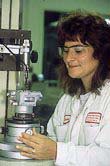
"Rectilinear optical instruments, which are designed to inspect mainly flat, straight-sided workpieces, are cumbersome and not reliably accurate for round surfaces," said Burrell. A rectilinear system would've required special workholding jigs and complex mathematical formulas to convert Cartesian measurements to polar, the language of customer specs. Set-up would have been time-intensive and awkward.
Another way of measuring, using a coordinate measuring machine (CMM), would have been somewhat more automated. "But, the drawback is that it, too, thinks and displays in X-Y-Zs, and IDs at several odd angles are likewise difficult to measure," noted Burrell. A CMM's system processor, software logic, and language are programmed for Cartesian or rectilinear measurement. So, with both flat measurement methods, inspectors have to convert the measurements from rectilinear to curvilinear, with the potential for system errors. By contrast, a roundness measuring system is set up in polar coordinates for parameters specifically related to roundness.
"The benefits in ease of use, accuracy, reliability of the results, and lower inspection cost per part more than justifies the cost of a special roundness tester, even if only 15-20% of the measurements to be made are curvilinear," said Burrell. Because of these benefits, IPT has improved yields of the curvilinear workpieces, lowered inspection costs, and maintained a competitive edge in a very competitive business. "It simply improved our process control and documentation," stated Burrell.
Following the Leader
IPT opened its Greenfield, IN, facility in August 1988 to manufacture parts for Honda Civics and Accords. Its Japanese parent company was already a Honda supplier and had considerable success on the same type of round parts with the Mitutoyo Roundtest inspection system. Thus, IPT was comfortable adopting the identical protocol and inspection method. The Mitutoyo system was supplied by Mitutoyo's U.S.-based company, MTI Corp. (Aurora, IL).
"In our high-tech automotive market, roundness specs are becoming tighter and more extensive, and customers require more documentation," according to Kevin McCarley, IPT's quality assurance manager. "And our machine operators routinely inspect their own parts right at the production line. The more round features per part to check, the greater the potential for error. We needed an inspection system that made it easy for them to get the curvilinear measurements right every time."
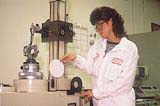
After looking closer into the Roundtest's capabilities, McCarley felt that the standard unit was a good fit. For his purposes, three roundness parameters would meet his immediate metrology needs — the Roundtest had measuring capabilities of up to ten. Magnification and resolution were higher than he needed — up to 20,000X with resolution of 0.1 m. The designated processor had the displaying and recording capabilities for his process control needs. In addition, he was satisfied with MTI's customer support based on installation and training experience.
The two companies worked together to set up three Roundtest units and train the staff on usage and form inspection. Now IPT trains most new operators in-house, with occasional refresher courses at the Aurora, IL facility.
The System in Operation
IPT dedicated one Roundtest system to process control and two to product development. All three units reside in the company's metrology lab. Primary components that are checked include fuel injectors and throttle bodies.
Twenty plant operators inspect representative samples of fuel injector and throttle parts offline in three shifts a day running six days a week. They bring sample lots into the lab and run the measurements. If the operators notice any drift, they make the corrections on the machine when they return to the plant. Three full-time and six back-up quality associates in the injector lab perform product development measurement with the aid of the two other units. The system is used about five to six times/day per operator.

On both the fuel injector and throttle parts, all of the roundness aspects on the OD and ID and their relationship to each other are critical. If any of them are off by a small fraction, the part will malfunction. IPT relies on the Roundtest for process control in order to keep the three R's in check before potential errors occur and are repeated. Any deviations from roundness specs or tolerances trigger immediate corrections to the production units.
Polar by Design
IPT operators and inspectors check three parameters on the fuel injectors: roundness, concentricity, and coaxiality. They hold roundness tolerances down to ±0.6 micron, concentricity and coaxiality to ±1 micron. On the throttle bodies, they check roundness and concentricity to similar tolerances.
"Since the Roundtest system's processor also speaks the ‘language of roundness,' we don't have to do any fancy programming," noted Burrell. The processor is already programmed in polar coordinates. For example, built-in roundness references include least squares mean circle, maximum inscribed circle, minimum circumscribed circle, and minimum zone circles.
In a typical inspection, which takes 7-10 minutes, an inspector picks a prescribed number of parts per lot. He fixtures the part onto the Roundtest's adjustable air-bearing turntable, enters the part number, and starts a manual centering and leveling sequence. He lowers the stylus to the top center of the part, takes a measurement, then repeats the same operation on the bottom center. This procedure creates an axial tilt to provide the mathematically exact part rotation angle.
Inspectors check the centering and leveling readout on a built-in vertical column digital LCD display as the Roundtest goes through the sequence. Once they complete the sequence, the device measures the ODs and IDs, then compares them to spec. Inspectors verify final measurements either on the LCD display or via graphs generated by the chart recorder and make pass/fail decisions. The ability to locate the exact area of deviation, evaluate its criticality to the part, and relate it back to the machines has improved accuracy in manufacturing and fostered tighter controls over quality.
State-of-the-Art Equipment
IPT is already modernizing in anticipation of changes that are coming. A desire for more sophisticated process control automation and the need for higher integration, speed, and efficiency prompted the search for newer state-of-the-art roundness testing. After evaluating four roundness testers, McCarley and Burrell have come full circle to the latest Mitutoyo Roundtest version equipped with Roundpak data processing. It features hands-free centering and leveling capabilities, and much higher precision than the earlier models. "We'll have four times better accuracy than now," explained Burrell. "The computer networking capability will enable us to install individual computers for each inspector, so they become more efficient right at their stations."
McCarley believes he'll fulfill a long-unrealized goal of keeping historical part data to assist in future product development. "We're going into the second millennium much better equipped to meet the demands of our competitive market than when we first started."