
Columbia Marking Tool, Inc. Introduces 'I-Mark' The New Generation Of Software And Controllers For Marking Machines
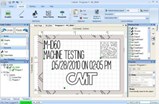
Years of benchmarking and development have now produced a software and control system with abilities never seen before for applying any type of mark by any type of marking machine or multiple machines.
Columbia Marking Tools, Inc. has been building tools, machines, and systems as well as developing new marking processes for placing identification marks in parts since 1960. Over that 50 year period, what started as a simple manual process of using metal stamps to hammer identification into parts has now become a sophisticated compilation of unique marking processes to provide traceability and part information, unique cosmetic looks, company logos, date codes and manufacturing information, as well as dials and graduation marks. The range of marking processes now includes laser, peen, scribe, roll and even embossing. The quantity of information required has increased as well, prompting the use of sophisticated 2D matrix codes that need to be accurately placed and read on all types of part surfaces. Because marking is very application oriented, the type of marking process to be used depends on part size and shape, material, production rates and even process integration.
"Today, there are many, many variables that have to be considered," says Andy Habedank, Columbia Marking Tool, Inc. chief engineering manager. "That's why we developed I-Mark. It not only provides Columbia with a new software and control system for all of our standard and specially-designed marking machines, but it also provides the marking machine industry with a software/controller retrofit package that will allow I-Mark to control other manufacturers marking equipment. The customer benefit includes the ability to have easier programming, operate faster and provide additional capabilities to incorporate testing, loading/unloading, inspection and vision verification. Just a simple adapter cable is all it takes to make the I-Mark software/controller retrofit part of your marking process."
Tim Ryder, Columbia Marking Tools technical service manager and controls engineer explains, "I-Mark software has a tremendous amount of horsepower, but it is extremely Windows user-friendly and easy to operate. There are basically two different modes of operation for the software. The first one is the basic program where the operator easily creates a layout for a mark to be made with any combination of graphics, text, date codes, proprietary fonts or 2D IUID codes including Military Specification 130. It also has the ability to store a wide variety of marking programs. The second is an advanced mode, which includes the ability to control other machine I/Os like automation, machine motions, part handling, gaging and vision cameras."
Ryder explains further, "Simple drag-and-drop functionality makes program creation and entity sizing easy. A wide variety of other non-printable marking utilities are also provided to set way points, inputs/outputs and even programmable dwell times. After the marking program is configured, the operator can preview the sequence of operations before actually marking and can modify the sequence if necessary. Any and all of the marking programs can be stored in files or in the controller's memory that can be easily retrieved. We've even included several dozen video tutorials to enable the operator to refresh his/her memory if they've forgotten exactly how to do something. A software manual is not needed because the entire HELP file is in the software and by going to our I-Mark web site all > updates can be downloaded through the internet." Ryder adds, "The software has been designed with the operator in mind. There is a Machine Activity Screen that provides a real time log of what the marking machine or a network of marking machines are doing. This is particularly useful because this stored log data can be used for troubleshooting. In operation, with proper networking, an operator could actually sit at a desk in an office and control, monitor and make necessary changes to programming on any number of marking machines…all remotely. Also, the software has incredible diagnostic capabilities. If there are issues on the marking machine that the customer cannot resolve, the I-Mark software can draw all parameters and files from the controller, compress them in a ZIP file, open an email and to automatically send it to Columbia Marking Tools for further evaluation."
"The I-Mark controller hardware is very unique to Columbia Marking Tools because it utilizes Ethernet connections for communications, programming and network integration," Andy Habedank points out. "It's really a sequence processor with a built-in digital oscilloscope that provides advanced diagnostics. Each controller is capable of controlling a servo or stepper motor on the marking machine with a 10 amp peak motor output per axis. There are currently up to 4-axes per controller. The drives are contained in a NEMA 4 industrial enclosure with (16) 24vdc digital I/O points split over 2 x 25 pin DIN connectors. The controller is designed to be plug-n-play. For example, if a drive should fail, one would simply plug in a new drive and it will auto-configure and program itself. Everything is nearly 100% interchangeable. Depending on the complexity of the marking machine application, an I-Mark software and controller package can typically be provided in a cost range from $3,500 to $8,500."
SOURCE: Columbia Marking Tools