
Using lasers for QC on the plant floor
In this case study, follow along as two job shop employees tell how a laser quality control system was implemented and the benefits they've gained from it.
By Dennis Gassner, VP/General Manager, and Jeff Huber, Toolroom Supervisor
RuMar Mfg Corp.
Upon examining quality control procedures, RuMar Mfg Corp. (Mayville, WI) decided it needed to improve QC techniques. Our customers expected increasingly shorter turnarounds and required kanban and kaisen practices, along with JIT deliveries. Our delivery time remained unchanged, but customers really wanted the parts in two to three days, if not two to three hours.
We continued to win prototype work, but we had to look at inspection alternatives and documentation improvement.
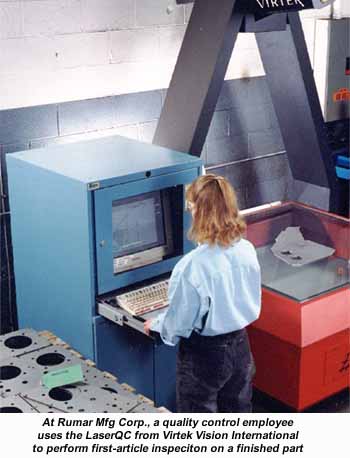
After a demonstration at IMTS of a new laser quality control machine—the LaserQC from Virtek Vision International, Inc. (Waterloo, Ontario, Canada)—we were impressed by its concept and potential. We bought it to reduce first-article inspection times. Today we are reaping the rewards.
QC Solution
The system is designed to reduce inspection time and increase green light time on CNC equipment. It prints color inspection records in real time, comparing parts to CAD drawings, and has a reverse engineering capability that produces CAD drawings from sample parts where none previously existed.
Knowing it had the potential to solve our QC bottleneck, we were excited by the 2D scanning system's features when we left the IMTS show. The system is designed for the shop floor, where it helps us save time in inspection and reverse engineering, thus decreasing machine idle time. We also can scan templates, create DXF files, and make real parts more quickly.
Using the system also ended the time-consuming task of manual dimensioning. However, we chose the LaserQC primarily for its plant floor design. Our operators can make parts and walk over to do first-article inspection and continuing audits throughout the release.
We've had good results. Today, there's no more QC bottleneck. In the past, we checked parts on a CMM or used calipers and squares, which was a lengthy procedure. And we couldn't properly inspect some parts. Sometimes customers had to approve first-article samples. By using the LaserQC, we've dramatically improved our reverse engineering and first-article inspection processes.
Making Improvements
When a file goes to the floor, the operator runs one sheet of material and takes the parts to the laser scanner to check the tolerances. By scanning the part, we get the actual dimensions. The LaserQC automatically superimposes the digitized part profile over the CAD image, for instantaneous identification of part variances or errors. If there are none, the order can be released.
We often receive flat part samples from customers. Before, various devices might have been used to manually capture the dimensions as closely as possible, after which engineering created CAD drawings. Today, we scan the parts and create a DXF file that we use as the customer's print. The scanner has removed many time-intensive tasks of the engineering function.
Throughput improvements and production increases are easy to detect. Producing color quality reports is so much quicker; the scanner freed our inspectors to concentrate on more critical work. The documentation savings are obvious, too. We no longer type the documentation forms to accompany customer products—they are printed directly from the LaserQC. Similarly, people need not manually document each dimension, because the scanner also produces these reports.
Competitive Advantage
This laser inspection technology has given us a competitive advantage. We bring prospective customers to the plant floor to showcase the LaserQC. It leaves a lasting memory of "high-tech automation" in the prospect's mind. It lets us show them how we have taken quality to the shop floor. In minutes, we can produce a part and generate a detailed report for the customer.
Idle time on the lasers and turret punch presses has also been minimized. Operators carry out first-article inspection as quickly as possible. Having the LaserQC inspection equipment next to the production equipment on the plant floor has helped tremendously.
Finally, the parts we're quoting and making now seem to have more contouring, round radii, arcing, and sweeping radii. Without the LaserQC, the increased contouring would create more challenges. This machine is an even greater asset to us than we anticipated when we first bought it.
RuMar Mfg Corp. is a privately held job shop with 160 employees that produces sheet metal and tube fabrication work with lasers, presses, welding equipment, and tube bending equipment.
Virtek Vision International, Inc., 785 Bridge St., Waterloo, Ontario Canada N2V 2K1. Tel: 519-746-7190. Fax: 519-746-3383.
Edited by Nancy Katz
Managing Editor, Metrology World.com
E-mail: nkatz@verticalnet.com